

Please note that the information provided below is the personal opinion of Mr Milan Schirlo, who is a therapist and an advocate of traditional Chinese medicine and a healthy lifestyle. Mr Schirlo does not promote any specific products or manufacturers of food supplements. Furthermore, this article is not connected to the sale of any products. The information is provided with the aim of disseminating publicly available knowledge, conclusions of expert studies, awareness, and personal findings regarding vital mushrooms and a healthy lifestyle.
For legislative reasons, I cannot state some information. Therefore, the text for some points is missing. I am working on republishing it. Thank you for your understanding.
Latin: Flammulina velutipes
Czech: Velvet shank
Chinese: Dong Gu/Jin Zhen Gu
Japanese: Enokitake
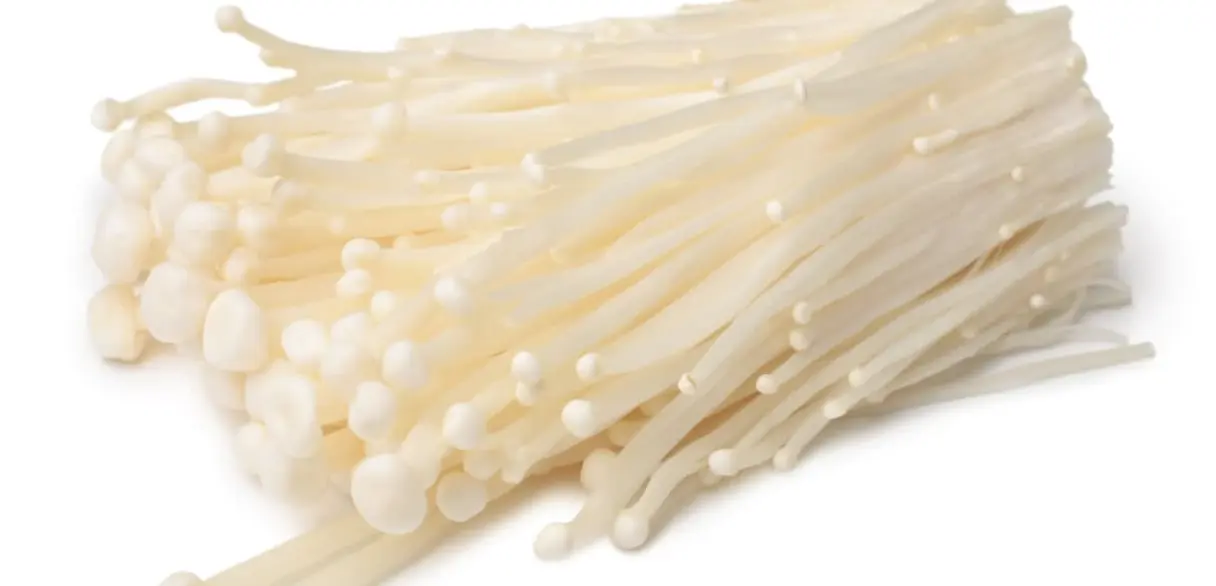
Enoki (Flammulina velutipes, velvet shank, Enokitake, golden needle mushroom, winter mushroom) is one of the most sought-after mushrooms worldwide. Enoki grows all over the world, but it mainly prefers cooler regions. Its season is in winter, which is also where one of its English names comes from. While other mushrooms have long since stopped growing, Enoki begins to appear, i.e., late November, December. Enoki can be found in clusters at the bases of trees; it is a saprophyte, meaning it draws nutrients from the host but without killing it. A mushroom that has access to UV light has a small golden, honey-coloured to darker brown cap. The stem is thin, straight, and hairy, which gives a velvety feel. Enoki is also grown commercially, in the cold and dark. Such mushrooms are white in colour. However, the content of nutrients and biologically active substances is the same as in wild-growing mushrooms.
Enoki has been used for millennia not only as food but also as a medicinal remedy. In history, Enoki was appreciated by the ancient Egyptians and Chinese. In Egypt, it was considered the mushroom of immortality and was therefore reserved only for pharaohs, similarly in China, where it is considered a life-extending mushroom. There are records from the year 900 AD, i.e., the Han dynasty, where the use of Enoki is described, including how to cultivate and grow it, i.e., prepare a suitable substrate, how to water it, etc.
While Asian countries had known Enoki since before our era, for the scientific world, Enoki was only registered in 1782, when M. A. Curtis classified it into the genus Agariceae. At that time, he assigned it the name Agaricus velutipes. Enoki only received its current name in 1951, thanks to R. Singer. Interest in Enoki increased in the last century after the Japanese scientist Ikekawa found a connection between Enoki and a reduced incidence of tumour diseases. In the area inhabited by mushroom growers, there was a much lower incidence of tumours. This is precisely connected to the fact that the mushroom growers also consumed the mushroom, and did so daily. Enoki thus proved to be a prevention against tumour diseases. It came into the focus of scientists and began to be extensively researched.
Nature (Si Qi): neutral
Taste (Wu Wei): sweet, slightly salty
Tropism (Gui Jing): spleen, stomach
1, Support for cancers
2, Regulation of the immune system
3, Food allergies
4, Support of the cardiovascular system
5, Anti-inflammatory effects
6, Skin problems
a, Mushrooms in the form of extracts (recommended form of use)
If you take mushrooms in the form of 30% extracts, I recommend:
Preventive use
For milder health problems
For more serious health problems
b, Mushrooms in tincture
c, Mushrooms in the form of powder (powder, biomass)
d, Dried mushrooms
None are known
Mushrooms, after removing water, are largely composed mainly of sugars, whether simple, or mainly complex, i.e., polysaccharides.
First, we will mention monosaccharides, i.e., they are formed by one sugar molecule. In Enoki, there is fucose, mannose, glucose, ribose, xylose, galactose, and mannitol.
Furthermore, there are disaccharides in Enoki, i.e., sugars composed of two sugar molecules, namely trehalose and sucrose.
The most important are polysaccharides, which consist of many sugars. Significant are mainly beta-glucans, which have immunostimulatory effects. Many polysaccharides have their own designations, e.g., SFR1, FVP2, PA3DE, and PA5DE.
In Enoki, there are also polysaccharides that are not soluble in water and absorbable, e.g., chitin, which represents rough fibre, which is "food" for intestinal bacteria. The correct composition of the intestinal microbiota is very important for our health.
Enoki, like other mushrooms, is a source of amino acids and proteins. It contains a whole spectrum of amino acids, i.e., those essential, which are created in the body, and those non-essential, which must be supplied, i.e., obtained together with food. If we look at the amino acids that are in the highest concentrations in Enoki, they are mainly glutamic acid, alanine, lysine, glycine, methionine, valine, isoleucine, phenylalanine, and threonine. It is precisely the amino acids that give the mushroom its taste and aroma. In this regard, amino acids with sulphur are most involved, i.e., methionine and cysteine.
From Enoki, it is also possible to obtain proteins. These are proteins with significant immunoregulatory effects. They are designated as FIPs, i.e., fungal immunoregulatory proteins.
It does not end there, however; in Enoki, it is also possible to find proteins such as flammin, flammulin, and velin, which are capable of limiting the activity of ribosomes, i.e., protein units that transcribe genetic information and create proteins according to it.
We cannot omit flammutoxin either. This compound acts cytolytically, i.e., it can kill cells. It disrupts its membrane and creates holes in it, which leads to the death of the cell. This is aimed mainly at red blood cells (erythrocytes), specifically the erythrocytes of humans, rats, rabbits, pigs, cats, dogs. Erythrocytes of horses, sheep, and goats are resistant to flammutoxin. There is no need to fear the consumption of Enoki. For the destruction of erythrocytes to occur, the mushroom would have to be administered in huge quantities! Moreover, its effectiveness is neutralised by calcium.
To demonstrate what doses could be toxic, we will use one study in which the authors injected certain doses of flammutoxin directly into the abdominal cavity of rats, until a dose of 2.45 mg/kg of weight led to damage to erythrocytes. From 1.8 kg of mushrooms, an extract is created that contains 425 μg/ml.
Important proteins in Enoki are also enzymes, the best known is proflamin, which exhibits anti-tumour effects.
Among proteins, there are also enzymes. Here we include, e.g., proflamin, which has anti-cancer effects. Furthermore, there are enzymes that break down carbohydrates, such as glycosyltransferase, polysaccharide lyase, glycoside hydrolase, etc.
Enoki also hides fats/fatty acids within itself. Unsaturated fatty acids, i.e., those that contain double bonds, have a higher percentage representation. 50% of all fatty acids are formed by unsaturated linoleic acid, the second is oleic acid. Saturated acids are represented in a smaller amount. They are represented by palmitic and stearic acid, these two form 15% of all fatty acids.
In all mushrooms, mineral and trace elements are contained. Their concentration is influenced by the presence of minerals in the mushroom's environment. In Enoki, it is possible to find potassium, sodium, calcium, magnesium, sulphur, phosphorus, iron, manganese, zinc, copper, etc.
Besides mineral and trace elements, there are also vitamins in Enoki, mainly those belonging to the B group, i.e., thiamine (B1), pantothenic acid (B5), riboflavin (B6), niacin. Also important is vitamin D, which is represented by ergosterol, i.e., vitamin D2. Enoki further contains vitamin E (tocopherol, namely alpha, beta, and delta) and provitamin A (beta-carotene) and other carotenoids, e.g., lycopene.
In the acetone extract from Enoki, these compounds were found:
and many others (see tab.)
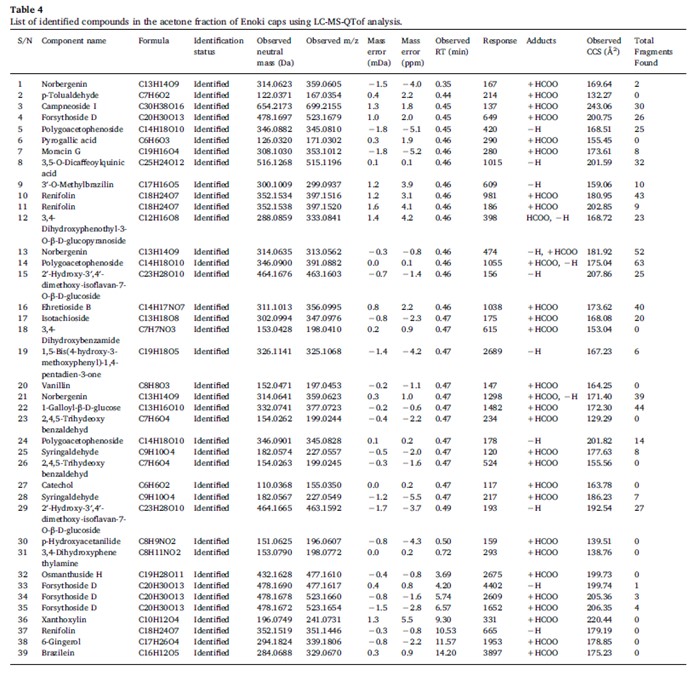
Source: https://www.sciencedirect.com/science/article/pii/S2314853518302518 https://doi.org/10.1016/j.bjbas.2018.07.012
Phenolic and heterocyclic compounds
These compounds have significant antioxidant, antimicrobial, and anti-tumour effects.
Enoki contains
In Enoki, there are also terpene compounds, they too, similarly to phenols, are strong antioxidants, moreover, they are very successful killers of cancer cells and infectious pathogens.
Various types of sesquiterpenes:
Monoterpenes
We already mentioned sterols when we introduced vitamin D, as it belongs among sterols. Further included in this group and represented in Enoki are
As you have noticed, Enoki contains a large amount of substances that have various effects, which Enoki then also has. The image below is an overview of the effects of Enoki, which we will analyse further.
Tang C, Hoo PC, Tan LT, Pusparajah P, Khan TM, Lee LH, Goh BH, Chan KG. Golden Needle Mushroom: A Culinary Medicine with Evidenced-Based Biological Activities and Health Promoting Properties. Front Pharmacol. 2016 Dec 7;7:474. doi: 10.3389/fphar.2016.00474. PMID: 28003804
Wang Y, Zhang H. Advances in the extraction, purification, structural-property relationships and bioactive molecular mechanism of Flammulina velutipes polysaccharides: A review. Int J Biol Macromol. 2021 Jan 15;167:528-538. doi: 10.1016/j.ijbiomac.2020.11.208.
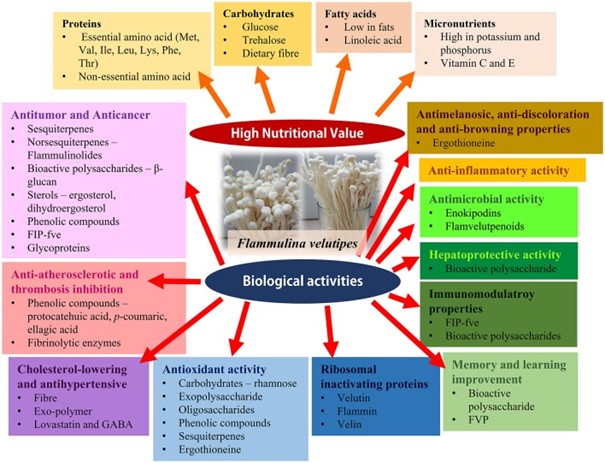
Tang C, Hoo PC, Tan LT, et al. Golden Needle Mushroom: A Culinary Medicine with Evidenced-Based Biological Activities and Health Promoting Properties. Front Pharmacol. 2016;7:474. Published 2016 Dec 7. doi:10.3389/fphar.2016.00474
Tumour diseases are becoming increasingly widespread among people. One of the reasons is also that we live longer and reach the age of our cancers. Of course, children and young people also suffer from cancer. Fortunately, many types of cancer can be treated and cured, but still a large number of people die from a tumour. Even the treatment itself is demanding. Scientists are looking for effective and safe treatment. They see hope in vital mushrooms.
Anti-tumour effects of Enoki were recorded between 1972 and 1986 by Dr Tetsuro Ikekawa. He noticed that in the Nagano area, where Enoki is grown extensively, the incidence of cancer is almost 40% lower than in other parts of Japan. He looked for an explanation and came to the conclusion that it is precisely the consumption of Enoki every day that reduces the incidence of cancer. It therefore functions as prevention against tumour diseases.
Most often, the anti-tumour effects of Enoki are tested on cell cultures. This means that cells of various types of cancer are grown in "dishes", bottles, so that they grow well. Then the mushroom is added to them and it is observed how the tumour cells react to the presence of the mushroom. Experiments were carried out, e.g., on cells of cervical, breast, lung, liver, stomach cancer, melanoma, etc. These tumour cells stopped multiplying in the presence of Enoki, and what is more, they began to die.
In experiments on animals, it was also possible to confirm the effects of Enoki. In animals with tumours that metastasise, the administration of FIP-fve leads to a reduction in tumours and a reduction in the number of metastases. In one experiment, it was proven that the administration of 10 mg of Enoki prolonged the survival time of rats by approx. 86%.
Another benefit of Enoki is also that if it is administered together with standard anti-tumour therapy, it can increase its effectiveness. It is possible to use a lower dose of a chemotherapeutic agent without reducing effectiveness.
We cannot omit the fact that Enoki stimulates the immune system and strengthens anti-tumour immunity. The immune system is a natural enemy of tumour cells.
Chang YC, Hsiao YM, Wu MF, Ou CC, Lin YW, Lue KH, Ko JL. Interruption of lung cancer cell migration and proliferation by fungal immunomodulatory protein FIP-fve from Flammulina velutipes. J Agric Food Chem. 2013 Dec 11;61(49):12044-52.
Yi C, Zhong H, Tong S, et al. Enhanced oral bioavailability of a sterol-loaded microemulsion formulation of Flammulina velutipes, a potential antitumor drug. International Journal of Nanomedicine. 2012;7:5067-5078. doi:10.2147/IJN.S34612.
Ng TB, Ngai PH, Xia L. An agglutinin with mitogenic and antiproliferative activities from the mushroom Flammulina velutipes. Mycologia. 2006 Mar-Apr;98(2):167-71.
Ohkuma T, Otagiri K, Ikekawa T, Tanaka S. Augmentation of antitumor activity by combined cryo-destruction of sarcoma 180 and protein-bound polysaccharide, EA6, isolated from Flammulina velutipes (Curt. ex Fr.) Sing. in ICR mice. J Pharmacobiodyn. 1982 Jun;5(6):439-44.
Yang, Wenjian Pei, Fei Shi, Ying Zhao, Liyan Fang, Yong Hu, Qiuhui. Purification, characterization and anti-proliferation activity of polysaccharides from Flammulina velutipes. Carbohydrate Polymers, Volume 88, Issue 2; 2012, pp. 474–480.
Lee, Si-Rim; Nam, Dong-Yun; Lee, Hyun-Jin; Park, Chul-Hong; Heo, Jin-Chul; Kim, Jong-Guk; Lee, Jin-Man; Lee, Chang-Yun; Park, Hee-Ju; Lee, Sang-Han. Analysis of Anti-Tumor Activity of Flammulina velutipes Extract on B16 cells. Korean Journal of Food Preservation Volume 16, Issue 4, 2009, pp.599-603.
Ikekawa, T., et. al., eds. 1989. "Twenty-years of Studies on Antitumor Activities of Mushrooms," Nagano Prefectural Research Institute of Rural Industry.
Ikekawa, T., Uehara, N., Maeda, Y., Nakanishi, M., Fukuoka, F., 1969. "Antitumor activity of aqueous extracts of edible mushrooms." Cancer Research 29: 734-735.
Ikekawa T, Maruyama H., Miyano T, Okura A, Sawaskai, Y., Naito, K., Kawamura, K., Shiratori, K., 1985. "Proflamin, a new antitumor agent: preparation, physicochemical properties and antitumor activity." Japanese Journal of Cancer Research 76: 142-148.
The correct function of the immune system is essential for our life. It is necessary for the immune system to protect us from danger from the outside (viruses, bacteria...) and from the inside (tumour cells...). Moreover, the defensive reaction must be sufficiently strong and long to remove the danger, but it must not be excessive and too long or too short, then damage to the organism can occur. It must also not attack harmless molecules, e.g., allergens, and mainly it must tolerate its own molecules, otherwise, autoimmune inflammation develops.
In experiments with Enoki and its influence on the immune system, the immunomodulatory proteins FIP-fve proved most successful. When these molecules are added to cells of the immune system, their activation occurs. They begin to multiply more and produce substances (cytokines) that have the ability to activate other cells, not just immune ones, e.g., IL-2, IL-4, IFN-γ, TNF-α, LT, IL-1.
If FIP-fve acts on macrophages, i.e., cells capable of engulfing and destroying foreign material or damaged cells and their parts, their ability to phagocytose particles (e.g., bacteria), process them, and display their molecules on their surface so that other cells of the immune system can also find them, increases. Mainly T lymphocytes, which then help antibody-producing B lymphocytes.
In one study, parts of the mushroom that are normally thrown away were given to young growing chickens. It turned out that thanks to Enoki, the chickens are able to create a larger amount of antibodies against viruses, both IgA and IgG. Higher reactivity of the immune system was captured.
Besides the activation of the immune system, Enoki can also dampen reactions. And mainly those damaging, pathological, perhaps allergic and autoimmune inflammations. In experiments with allergic rodents, it was proven that the administration of Enoki leads to the alleviation of symptoms and also values of IgE antibodies, which play an important role in allergic reactions. A good effect was also proven in mice with asthma. The part of the mice that received Enoki had better lung function, the incidence of shortness of breath attacks was reduced, and also the production of mucus in the airways. Allergic inflammation in the lungs was significantly reduced, etc.
Enoki also acts positively on intestinal inflammations, colitis, and analogues of Crohn's disease and ulcerative colitis in mice. If intestinal inflammation is induced in mice and then parts are administered Enoki, the mice with Enoki have a milder course. There is an alleviation of inflammation, production of cytokines that dampen inflammation, diarrhoea disappears, weight loss does not occur, etc.
Enoki acts on the intestine not only anti-inflammatorily but also supports the correct composition of the intestinal microflora, which then also acts anti-inflammatorily.
The immune system is also responsible for healing processes. In experiments with skin damage in rats and mice, the application of Enoki led to the acceleration of the healing of skin defects.
Chang HH, Hsieh KY, Yeh CH, Tu YP, Sheu F. Oral administration of an Enoki mushroom protein FVE activates innate and adaptive immunity and induces anti-tumor activity against murine hepatocellular carcinoma. Int Immunopharmacol. 2010 Feb;10(2):239-46.
Cheah IK, Halliwell B. Ergothioneine; antioxidant potential, physiological function and role in disease. Biochim Biophys Acta. 2012;1822(5):784-93.
Wu M, Luo X, Xu X, Wei W, Yu M, Jiang N, Ye L, Yang Z, Fei X. Antioxidant and immunomodulatory activities of a polysaccharide from Flammulina velutipes. J Tradit Chin Med. 2014;34(6):733-40.
Yan Z-F, Liu N-X, Mao X-X, Li Y, Li C-T. Activation Effects of Polysaccharides of Flammulina velutipes Mycorrhizae on the T Lymphocyte Immune Function. Journal of Immunology Research. 2014;2014:285421.
Zheng-Fei Yan, Nai-Xu Liu, Xin-Xin Mao, Yu Li, and Chang-Tian Li, “Activation Effects of Polysaccharides of Flammulina velutipes Mycorrhizae on the T Lymphocyte Immune Function,” Journal of Immunology Research, vol. 2014, Article ID 285421, 7 pages, 2014.
Chang YC, Hsiao YM, Hung SC, Chen YW, Ou CC, Chang WT, Lue KH, Ko JL. Alleviation of Dermatophagoides microceras-induced allergy by an immunomodulatory protein, FIP-fve, from Flammulina velutipes in mice. Biosci Biotechnol Biochem. 2015;79(1):88-96.
Chu PY, Sun HL, Ko JL, Ku MS, Lin LJ, Lee YT, Liao PF, Pan HH, Lu HL, Lue KH. Oral fungal immunomodulatory protein-Flammulina velutipes has influence on pulmonary inflammatory process and potential treatment for allergic airway disease: A mouse model. J Microbiol Immunol Infect. 2015. pii: S1684-1182(15)00823-3.
Hsieh CW, Lan JL, Meng Q, Cheng YW, Huang HM, Tsai JJ. Eosinophil apoptosis induced by fungal immunomodulatory peptide-fve via reducing IL-5alpha receptor. J Formos Med Assoc. 2007;106(1):36-43.
Mahfuz S, Song H, Miao Y, Liu Z. Dietary inclusion of mushroom (Flammulina velutipes) stem waste on growth performance and immune responses in growing layer hens. J Sci Food Agric. 2019 Jan 30;99(2):703-710. doi: 10.1002/jsfa.9236.
Zhao R , Ji Y , Chen X , Su A , Ma G , Chen G , Hu Q , Zhao L . Effects of a β-type glycosidic polysaccharide from Flammulina velutipes on anti-inflammation and gut microbiota modulation in colitis mice. Food Funct. 2020 May 1;11(5):4259-4274. doi: 10.1039/c9fo03017d.
Xu H, Liu L, Cao C, Lu W, Zhu Z, Guo Z, Li M, Wang X, Huang D, Wang S, Cheng S. Wound Healing Activity of a Skin Substitute from Residues of Culinary-Medicinal Winter Mushroom Flammulina velutipes (Agaricomycetes) Cultivation. Int J Med Mushrooms. 2019;21(7):683-691. doi: 10.1615/IntJMedMushrooms.2019031175.
Infections, or microorganisms that cause them, are everywhere around us. It depends on the immune system how it deals with them and allows them to multiply and cause illness.
For viral infections, there is usually no treatment, only relief, i.e., lowering temperature, pain, etc. Bacterial, parasitic, and fungal infections are usually treatable, but there is a problem with the increasing resistance of these pathogens to treatment. Medicines do not destroy them. It is therefore necessary to look for new, effective, and safe substances that can destroy pathogens. Scientists are turning to nature and also to Enoki.
On one hand, the mushroom supports the immune system and its defences, and on the other hand, it contains substances that are toxic to pathogens.
In Enoki, antiviral effects have been confirmed. This happens because Enoki prevents the entry of the virus into the cell or its multiplication in the cell, i.e., it blocks, e.g., enzymes that it needs for its replication. It acts in this way, e.g., on HIV, influenza virus, or herpes viruses.
Even bacteria are not immune to the action of Enoki. Tests are most often carried out by growing a culture of bacteria on dishes, to which Enoki is added, and it is observed how the bacterial colonies change. Enoki limits the growth of colonies of golden staphylococcus, pseudomonads, Bacillus subtilis, etc. It turned out that Enoki can also suppress the multiplication of Streptococcus mutans, which is found in the oral cavity and participates in the formation of dental caries. Enoki could therefore be added to toothpaste and would serve as prevention of dental caries. If we look at the individual components of Enoki, e.g., enokipodins A to D are capable of destroying B. subtilis, flamvelutpenoids A to D the bacterium Escherichia coli and golden staphylococcus.
Besides viruses and bacteria, Enoki is also used in the fight against moulds and pathogenic fungi. It can defeat, e.g., Ophiostoma ulmi, Fusarium oxysporum, and Candida albicans and Aspergillus fumigatus.
We cannot omit the antiparasitic effects of Enoki. An effect of Enoki against nematodes, or their larvae, was proven, these were species belonging to Panagrellus.
Chang YC, Chow YH, Sun HL, Liu YF, Lee YT, Lue KH, Ko JL. Alleviation of respiratory syncytial virus replication and inflammation by fungal immunomodulatory protein FIP-fve from Flammulina velutipes. Antiviral Res. 2014 Oct;110:124-31
Wang H, Ng TB. Isolation and characterization of velutin, a novel low-molecular-weight ribosome-inactivating protein from winter mushroom (Flammulina velutipes) fruiting bodies. Life Sci. 2001;68(18):2151-8.
Chang YC, Chow YH, Sun HL, Liu YF, Lee YT, Lue KH, Ko JL. Alleviation of respiratory syncytial virus replication and inflammation by fungal immunomodulatory protein FIP-fve from Flammulina velutipes. Antiviral Res. 2014;110:124-31.
Ishikawa NK, Fukushi Y, Yamaji K, Tahara S, Takahashi K. Antimicrobial cuparene-type sesquiterpenes, enokipodins C and D, from a mycelial culture of Flammulina velutipes. J Nat Prod. 2001;64(7):932-4.
Culinary-Medicinal Winter Mushroom, Flammulina velutipes (Agaricomycetes) against Oral Pathogen Streptococcus mutans. Int J Med Mushrooms. 2020;22(2):115-124. doi: 10.1615/IntJMedMushrooms.2020033335.
Kashina S, Villavicencio LL, Balleza M, Sabanero GB, Tsutsumi V, López MS. Extracts from Flammulina velutipes Inhibit the Adhesion of Pathogenic Fungi to Epithelial Cells. Pharmacognosy Res. 2016;8(Suppl 1):S56-60.
Ferreira JM, Carreira DN, Braga FR, Soares FEF. First report of the nematicidal activity of Flammulina velutipes, its spent mushroom compost and metabolites. 3 Biotech. 2019 Nov;9(11):410. doi: 10.1007/s13205-019-1951-x.
Fats are indispensable for our life, they are, e.g., part of cell membranes and are a source of energy. A problem arises, however, if there is too much of them in the body. In such a case, they are deposited in vascular walls and atherosclerosis develops, into the liver and hepatosteatosis arises, and into other organs. If we take only blood vessels, then due to the deposition of fats, damage to vessels occurs, inflammation, vessels lose elasticity, their diameter decreases... this leads to an increase in blood pressure, an increase in the load on the heart, an increase in blood clotting, etc.
It is therefore important to monitor fat values in the blood and address them in time if they are elevated.
Enoki was tested to see if it can lower fat values. Most often, experiments are carried out on rodents (mice, rats, hamsters), which are fed a high-fat diet, which leads to an increase in fats in the blood and weight. Then, part of the animals is administered Enoki and part is not, and the condition of the animals from both groups is compared. Animals with Enoki have lower levels of total cholesterol, and also bad LDL cholesterol. However, Enoki also increases the level of good HDL cholesterol.
During liver analysis, it was confirmed that thanks to the decrease in fat concentration, there is also a decrease in fat deposition in the liver.
The reduction of fat levels alone does not protect only the liver, but also the cardiovascular system. Above, we mentioned that atherosclerosis and the formation of plaques in vessels is also associated with the risk of blood clots, thrombi, which can break off and be embolised, e.g., into the lungs or brain and endanger the patient's life. Enoki can limit excessive blood clotting. It reduces the clumping of blood platelets and slows down the formation of a blood plug. It also slows down blood clotting as such. Moreover, it contains enzymes that can break down a blood plug, i.e., they have fibrinolytic activity.
Enoki also has the potential to lower blood pressure. In an experiment on rats with high blood pressure, the administration of powder from Enoki, which was enriched with gamma-aminobutyric acid (GABA), led to a reduction in blood pressure by up to 30 mmHg. This reduction is given by the regulation of the autonomic nervous system, the sympathetic. Enoki can also lower blood pressure by blocking the angiotensin-converting enzyme. Thanks to this, there is no increase in angiotensin II, which increases blood pressure. On this principle, medicines that we know as ACEI are created.
Ming-Yei Yeh, Wen-Ching Ko, Li-Yun Lin, Hypolipidemic and Antioxidant Activity of Enoki Mushrooms (Flammulina velutipes). Biomed Res Int 2014;2014:352385.
Yasuhito Nobushi, Yuki Hamada, Ken Yasukawa. Inhibitory Effects of the Edible Mushroom Flammulina velutipes on Lipid Accumulation in 3T3-L1 Cells. Journal of Natural Medicines 70(2) in press May 2016.
Fukushima M, Ohashi T, Fujiwara Y, Sonoyama K, Nakano M. Cholesterol-lowering effects of maitake (Grifola frondosa) fiber, shiitake (Lentinus edodes) fiber, and enokitake (Flammulina velutipes) fiber in rats. Exp Biol Med (Maywood). 2001;226(8):758-65.
YANG, BYUNG-KEUN1 , JUN-BO PARK, AND CHI-HYUN SONG. Hypolipidemic Effect of Exo-Polymer Produced in Submerged Mycelial Culture of Five Different Mushrooms. J. Microbiol. Biotechnol. (2002), 12(6), 957–961.
Akira Harada, Takeshi Nagai and Miho Yamamoto. Production of GABA-Enriched Powder by Flammulina velutipes and Its Antihypertensive Effects in Spontaneously Hypertensive Fats. http://www.isms.biz/proceedings/beijing/volume-18-part-1-article-59/
Oxidative stress is given by increased production and neutralisation of free radicals. Free radicals arise in the organism during the metabolism of nutrients, immune reaction, etc. They are, however, neutralised by enzymes in the body and other compounds. In the case of stress, exposure to harmful substances, infections, etc., production of free radicals increases and the body does not manage to neutralise them. Oxidative stress occurs, which damages, e.g., fats in cell membranes, but also DNA. Oxidative stress accelerates degeneration in the organism, can be a trigger for tumour growth, etc.
Components in Enoki remove free radicals, and thus reduce oxidative stress, they therefore function as prevention of many diseases. They also support the activity of the body's own enzymes, e.g., superoxide dismutase.
In experiments on animals, antioxidant effects were confirmed. It is possible to measure the values of compounds that arise only in the presence of oxidative stress. Exposure to a toxic substance in animals increases the production of free radicals and, e.g., malondialdehyde, which arises by the reaction of oxygen radicals with fats in membranes. In animals that take Enoki, the levels of this compound decrease.
Wu M, Luo X, Xu X, Wei W, Yu M, Jiang N, Ye L, Yang Z, Fei X. Antioxidant and immunomodulatory activities of a polysaccharide from Flammulina velutipes. J Tradit Chin Med. 2014;34(6):733-40.
Bao HN, Ushio H, Ohshima T.Antioxidative activities of mushroom (Flammulina velutipes) extract added to bigeye tuna meat: dose-dependent efficacy and comparison with other biological antioxidants. J Food Sci. 2009;74(2):C162-9.
Mohammad Azizur Rahman, Noorlidah Abdullah, and Norhaniza Aminudin, “Antioxidative Effects and Inhibition of Human Low Density Lipoprotein Oxidation In Vitro of Polyphenolic Compounds in Flammulina velutipes (Golden Needle Mushroom),” Oxidative Medicine and Cellular Longevity, vol. 2015, Article ID 403023, 10 pages, 2015.
For us, for people, the brain is very important and a decline in brain functions represents a big problem. Brain functions decrease with passing years, the brain is exposed to oxidative stress for many years, mild inflammation, it can be damaged by various infections, ischaemia (damage to vessels in the brain), deposition of poorly created proteins in the brain (beta-amyloid in Alzheimer's disease). All this leads to a loss of neurons, brain cells.
We already mentioned that Enoki reduces oxidative stress, suppresses inflammation, destroys many viruses, protects vessels, even those in the brain, and thus also helps to protect the brain.
Many studies have taken place confirming the protective influence of Enoki. In one, rats were administered scopolamine, which causes disruption of memory, and part of these treated rats received polysaccharides from Enoki. In these rats, an improvement in memory occurred, they were able to learn new things better, restoration of already acquired abilities and knowledge occurred. Scientists found that the administration of Enoki increased the production of the neurotransmitter acetylcholine, which is involved in the transmission of impulses in the brain. Normalisation of serotonin, dopamine, and noradrenaline levels also occurred.
It is precisely the increase in serotonin levels that also has antidepressant effects.
In another study, mice were exposed to scopolamine and part of them were also administered polysaccharides from Enoki. It was found that Enoki improves brain functions, and surprisingly thanks to the fact that Enoki modulates the composition of intestinal microflora, thanks to which inflammation and damage to the brain are reduced.
In another study, scientists induced a state similar to Alzheimer's disease in humans in rats. A decline in brain functions occurred, their ability to navigate mazes decreased. Part of the rats was administered Enoki with ginsenosides. This had an antioxidant effect, the loss of nerve cells decreased, and these rats had better brain functions.
Wenjian Yang, Yong Fang, Jin Liang, Qiuhui Hu. Optimization of ultrasonic extraction of Flammulina velutipes polysaccharides and evaluation of its acetylcholinesterase inhibitory activity. Food Research International 44(5):1269-1275.
Su A, Yang W, Zhao L, Pei F, Yuan B, Zhong L, Ma G, Hu Q. Flammulina velutipes polysaccharides improve scopolamine-induced learning and memory impairment in mice by modulating gut microbiota composition. Food Funct. 2018 Mar 1;9(3):1424-1432. doi: 10.1039/c7fo01991b.
Zhang Y, Li H, Yang X, Jin G, Zhang Y. Cognitive-enhancing effect of polysaccharides from Flammulina velutipes on Alzheimer's disease by compatibilizing with ginsenosides. Int J Biol Macromol. 2018 Jun;112:788-795. doi: 10.1016/j.ijbiomac.2018.02.040..
The liver is a very important organ, it ensures detoxification, elimination of harmful substances, synthesises many proteins, including those involved in the immune response or blood clotting, also produces hormones, is involved in the metabolism of nutrients, etc. It has a great regenerative ability, but even so, it can be damaged.
We already mentioned that Enoki lowers fat values in the blood, thereby preventing them from being deposited in the liver, and damaging it. Moreover, Enoki destroys viruses that attack the liver, i.e., hepatitis B and C viruses. Another protective factor is also that Enoki reduces inflammation, which can be triggered by the presence of fats, viruses, toxins, autoimmune reaction..., it also reduces oxidative stress, and that directly, but also by increasing the activity of the enzyme superoxide dismutase.
Studies that were carried out on animals that were given toxic liver, proved that if Enoki is also added, the impairment of the liver is much smaller, and moreover, regeneration is supported.
Y. Meng, J. Yan, G. Yang, Z. Han, G. Tai, H. Cheng, Y. Zhou, Structural characterization and macrophage activation of a hetero-galactan isolated from Flammulina velutipes, Carbohydr. Polym. 183 (2018) 207–218, https://doi.org/10.1016/j.carbpol.2017.12. 017.
M. Boll, L.W. Weber, E. Becker, A. Stampfl, Mechanism of carbon tetrachlorideinduced hepatotoxicity, J. Biosci. 56 (2001) 649–659, https://doi.org/10.1515/znc2001-7-826
Chou WT, Sheih IC, Fang TJ. The applications of polysaccharides from various mushroom wastes as prebiotics in different systems. J Food Sci. 2013;78(7):M1041-8.
Huang, Li; Chen, Ming; Li, Siqian; Shah, Nagendra P. Antioxidant activities and bifidogenic properties of water-soluble crude polysacharide preparations from Flammulina velutipes and Hypsizygus marmoreus mushrooms. International Journal of Probiotics & Prebiotics10.1 (Feb 2015): 37-42.

Characteristics and effects of mushrooms according to traditional Chinese medicine

Description of herbal blends, effects according to Chinese medicine and main usage

Dietary recommendations including individual foods for specific patterns

Characteristics and effects of herbs according to traditional Chinese medicine

Characteristics of food and its influence on individual organs

Classification of herbs and mushrooms by individual diseases


Subscribe to our newsletter and you won't miss any promotions or important information