


You turn out the lights in the evening. The house goes quiet. And in that silence, it begins – whistling, hissing, ringing. During the day, it is drowned out by traffic, work, and conversations. But in the evening, it is back again. And anyone who knows it understands how exhausting it can be.
Tinnitus – ringing in the ears – is estimated to affect roughly one in ten adults. The number of those affected increases with age. And most of the people I talk to about it in my practice have heard a similar sentence from their doctor: "The examinations are fine. You will just have to learn to live with it." Sometimes they end up on antidepressants.
In this article, we will look at tinnitus from both sides. First, what Western medicine says about it. Then, how Chinese medicine views it – why it occurs, how to identify the type, and what can be done about it. So, let's get to it.
Tinnitus is not a disease. It is a symptom. A person hears a sound that has no external source – whistling, hissing, humming, chirping, or ringing. Sometimes it hums as if an aeroplane were taking off inside your head. However, it is usually a soft hissing or whistling sound. Sometimes in one ear, sometimes in both, sometimes "in the middle of the head".
Most tinnitus is so-called subjective – only the person who has it can hear it. More rarely, it is objective tinnitus, which has a real source in the body. Typically a pulsing sound in the rhythm of the heartbeat, which is related to the blood vessels around the ear.
Noise-induced hearing loss – concerts, noisy workplaces, loud headphones.
Age-related hearing loss – the most common cause in people over 50.
Earwax, middle ear infections, blocked Eustachian tube due to a cold.
Cervical spine and jaw joint – stiff neck, teeth grinding.
Blood pressure and blood vessels.
Certain medications – for example, high doses of acetylsalicylic acid, certain antibiotics, diuretics or cytostatics.
Menière's disease – tinnitus along with dizziness and fluctuating hearing.
Stress, fatigue and insomnia – tinnitus does not usually cause it, but it significantly amplifies it.
And now for the important part. Today it is known that sound does not only originate in the ear. When the inner ear sends less signal to the brain, the brain "turns up the volume". And what we hear is partly this "amplifier noise". That is why tinnitus is so closely related to attention, fear and tension. The more we focus on it and the more it scares us, the louder we hear it.
Western medicine does not yet have a drug that would reliably eliminate tinnitus. That is why the phrase "you have to learn to live with it" is used. It is not indifference. It is honesty. However, for someone who cannot sleep because of the ringing, that does not help much.
Before we delve into Chinese medicine, it is necessary to state when it makes no sense to wait. See an ENT specialist as soon as possible, ideally on the same day, if:
tinnitus appeared suddenly and was accompanied by hearing loss – this could be sudden sensorineural hearing loss, where days, not weeks, matter,
it is only in one ear and does not go away,
it pulses in time with your heartbeat,
it is accompanied by severe dizziness, balance disorders, facial paralysis, or other neurological symptoms,
it appeared after a head injury,
the ear is painful or there is discharge.
Chinese medicine is not a substitute for a medical examination in these situations. It can be a good supplement – but only once we know what we are dealing with.

Chinese medicine does not just ask "what is wrong with the ear". It asks what is happening in the whole body that has manifested specifically in the ears. Tinnitus usually involves three organ systems.
Kidneys. The Kidneys "open into the ears". In other words – good hearing depends on the strength of the Kidneys and their Jing essence, the basic reserve of life force. We inherit Jing essence from our ancestors and it decreases with age. It depletes faster during long-term overexertion, lack of sleep, frequent childbirth or chronic illness. That is why tinnitus is so closely associated with age.
Liver. The Liver stores blood and ensures the smooth flow of Qi – as well as emotions. The Gallbladder meridian, which belongs to the Liver, runs around the ear. When tension, anger or heat accumulate in the Liver, it has a path upwards, to the head and ears. Migraines or hypertension can have a similar cause.
Spleen. The Spleen produces Qi and blood from food and sends pure Qi upwards to the senses. When it is weakened, the ears do not receive enough nourishment. And when it cannot handle dampness, phlegm is formed, which can "block" the ear.
In a cascade, it looks like this:
The Kidneys and Liver share a common source – Yin substances: Yin, blood, Jing. These are fluids and nourishment that cool, moisten and keep the body calm.
When these substances diminish (age, overwork, lack of sleep, menopause), Yin can no longer keep Yang in place.
Liver Yang – the active, warming, mobile component – loses its anchor and rises up into the head.
In the head, this manifests as ringing in the ears, headache, dizziness, red eyes, insomnia.
This is important to understand. Sound in the ear is often fullness above, but its root is emptiness below. And that is why it is not enough to just "calm" the head. It is necessary to replenish below what is missing.
In Chinese medicine, we divide tinnitus into two basic groups. Deficiency means that something is missing – the ears are not sufficiently nourished. Excess means that there is an excess of something – heat, Yang or phlegm pushing upwards. In practice, they are often combined. But for the sake of understanding, it is good to separate them first.
Deficiency
Yin Deficiency of the Kidneys (and Liver) – the most common pattern in people over 50 and women going through the menopause.
Quiet humming or chirping, starting gradually.
Worse in the evening, at night and when tired.
Often accompanied by gradual hearing loss.
Additionally, weakness and pain in the lower back and knees, night sweats, hot flushes, dry mouth, poor sleep, weaker memory.
Qi and Blood Deficiency (Spleen) – common in people who are exhausted, post-illness, or have weaker digestion.
Humming that worsens after exertion, when standing, or when skipping meals.
Relief when lying down and after resting.
Additionally, fatigue, pallor, dizziness when standing up quickly, poor appetite, loose stools, weaker eyesight.
Excess
Rising Yang or Liver Fire – typically in people under pressure, with high blood pressure, or after severe agitation.
Loud whistling or high-pitched ringing, often appearing suddenly.
Worsens with stress, anger, or after alcohol.
Accompanied by headache (temples, crown), red eyes, bitter taste in the mouth, irritability, flushed face, poor sleep with many dreams.
Phlegm (often with heat) – in people who are overweight, consume a diet high in sugar and fat, or have a weaker Spleen.
Buzzing and a feeling of a blocked ear, as if it were "underwater".
Worse after a heavy meal.
Accompanied by a heavy head, dizziness, phlegm, a sticky feeling in the mouth, and sometimes nausea.
Fullness also includes external wind – tinnitus that comes on suddenly after a cold, along with a blocked ear. This is usually short-lived and typically subsides with the infection. If it does not, it may be an undertreated infection that has remained in the body.
In my experience, I see pure patterns less often. Most frequently, it is a combination: the root is deficiency (Yin of the Kidneys and Liver), the manifestation is excess (rising Yang). A person is exhausted, sleeps little, is under pressure – and in the evening, their ears ring. For therapists: the root and branches need to be addressed simultaneously; in the more acute phase, focus more on subduing the branches, later on nourishing the root.
In the surgery, I ask a few simple questions. You can try many of them yourself at home.
How did it start? Suddenly, overnight – more likely excess. Gradually, over months and years – more likely deficiency.
What does it sound like? A high-pitched, sharp whistling, loud humming or ringing – usually excess. A quiet rustling, soft whistling, chirping, "like wind in wires" – usually deficiency.
The palm test. Press your palms firmly against your ears and wait for a moment. If the sound becomes muffled or provides relief, it points more towards deficiency. If it does not change or gets louder, it points more towards excess.
When does it get worse? When tired and in the evening – Kidneys, Qi and blood. During stress and anger – Liver. After a heavy meal – phlegm.
| Deficiency | Excess |
Onset | gradual | sudden |
Sound | quiet humming, chirping | loud whistling, ringing, roaring |
Palms on ears | sound is muffled | no change or worse |
Aggravated by | fatigue, evening, exertion | stress, anger, alcohol, heavy meals |
Hearing | gradually worsens | blocked ear, feeling of pressure |
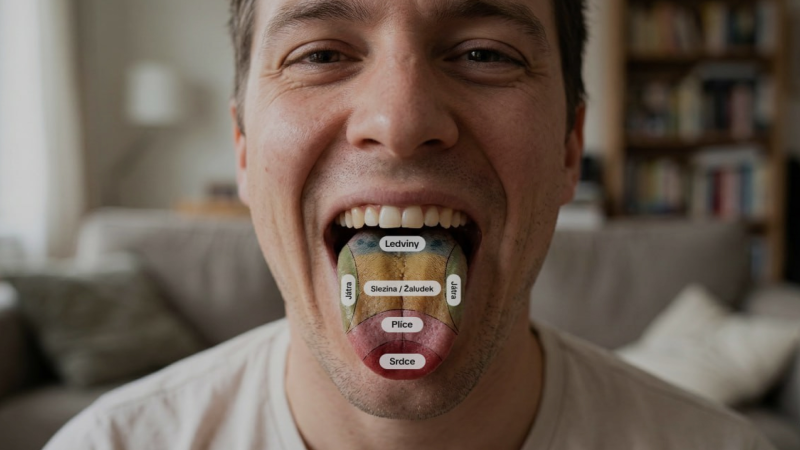
Tongue | red without coating (Yin), or pale (Qi and blood) | red with yellow coating (Liver fire), greasy coating (phlegm) |
Pulse | thin, weak, sometimes rapid | wiry, slippery, strong |
For therapists. The combination of tongue, pulse and accompanying symptoms will tell you the most. The sound itself is a guide, not a diagnosis. In older people with deteriorating hearing, Kidney deficiency usually plays a part, even if the sound seems like excess. And watch out for high blood pressure – rising Liver Yang is very common there and needs to be taken into account when choosing a blend.
And you ask yourself: okay, but what should I do then? The solution usually has several layers. Herbs are one of them. But without changing how we live, they often only help partially.
Lifestyle
Sleep. Sleep is the best way to replenish Yin and blood. Ideally, go to sleep by 11 p.m. Those who sleep little in the long term are drawing on their Kidney reserves.
Moderation in work and rest. Do not overwork yourself. But do not just "switch off" in front of a screen in the evening either – that does not replenish Yin.
Emotions and stress. This is key in cases of Liver excess. Exercise in the fresh air, walking, Qi Gong, breathing exercises. Those who carry long-term tension often hear it in their ears as well.
Diet. In cases of heat and rising Yang, limit alcohol, coffee, spicy and grilled foods. In cases of phlegm, limit sweet, fatty, dairy and cold foods. In cases of deficiency, warm, cooked food, broths, regularity.
Cervical spine and jaw. Relax the neck, do not clench your teeth. If you grind your teeth in your sleep, address it with your dentist.
Protect your hearing. Only enter noisy environments with protection, keep headphones at a low volume.
Do not be in absolute silence. This is a practical piece of advice that has worked well for me. A quiet sound in the background – the hum of a fan, a radio playing softly – helps the brain not to focus so much on the ringing. Especially in the evening when falling asleep.
Herbal blends according to the pattern
Pattern | Mixture | When to consider it |
Kidney and Liver Yin deficiency, rising Yang | 076 Utišení zvonků (Er Long Zuo Ci Wan) | tinnitus and age-related hearing loss, dizziness, headache, red eyes; the most commonly used mixture |
Qi and Blood deficiency | 016 Zbystření smyslů (Yi Qi Cong Ming Wan) | tinnitus with fatigue, weaker vision and hearing, poor memory; directs nourishment to the ears and eyes |
Rising Yang and internal wind | 088 Utopení větru (Tian Ma Gou Teng Yin) | loud tinnitus, headache, stiff neck, pressure in the eyes, high blood pressure |
Liver Fire | 078 Modrý hořec (Long Dan Xie Gan Tang) | sudden loud whistling, bitter taste in the mouth, irritability to explosiveness; rather short-term |
Phlegm | 056 Sailor's Walk (Ban Xia Bai Zhu Tian Ma Wan) | buzzing with dizziness, heavy head, phlegm, sticky feeling in the mouth |
Women in menopause | 086 Hot Flushes (Geng Nian An Pian) | tinnitus along with hot flushes, night sweats, restlessness and insomnia |
The usual dosage for tinctures applies: 1 drop per 1 kg of body weight per day, divided into 2–3 doses, on an empty stomach. As many kilos as I weigh, that many drops. In cases of excess patterns, we can even double the dose.
Vital Mushrooms
Mushrooms are not the primary treatment here. But as a support, they have their place.
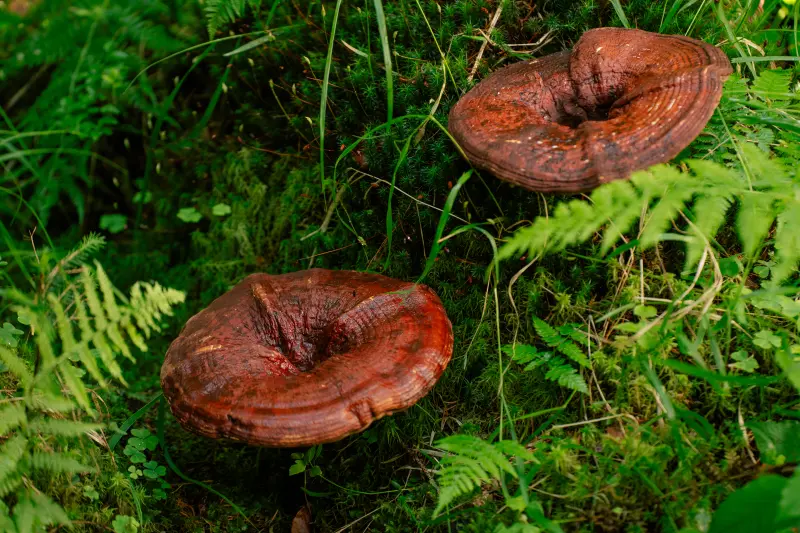
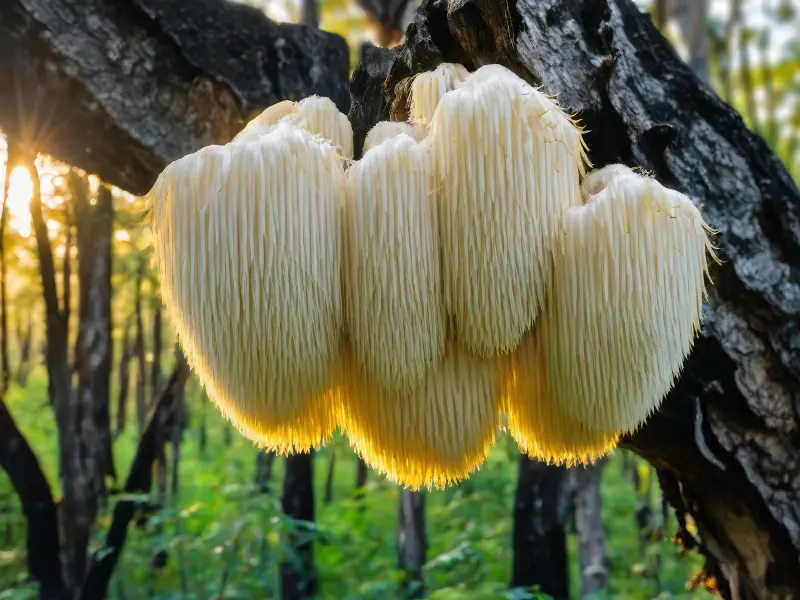
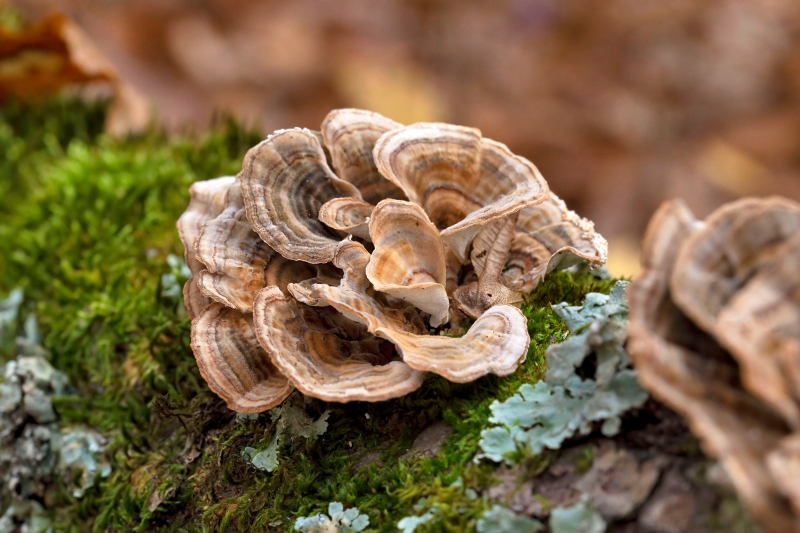
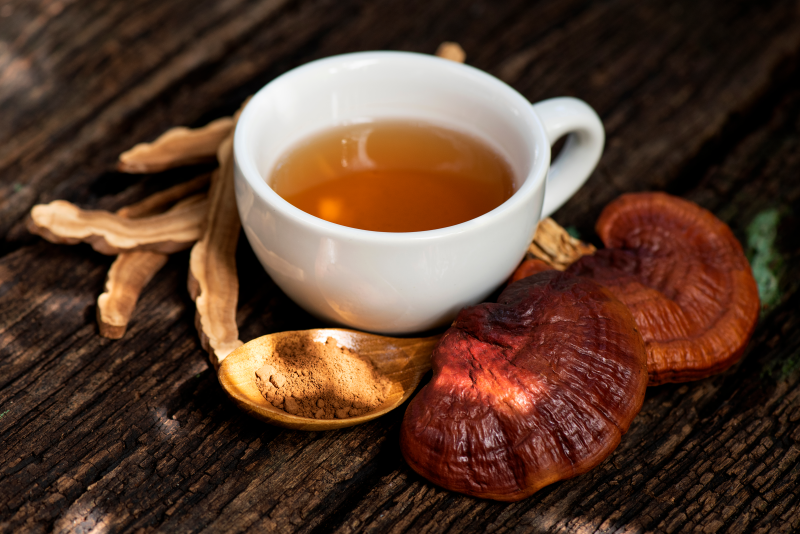
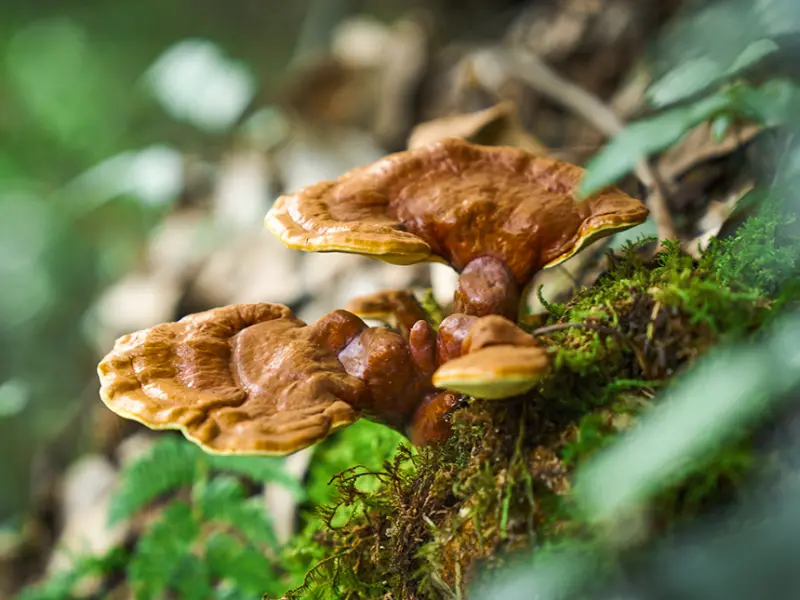
Reishi – supports blood and sleep, calms the mind. It is suitable where tinnitus goes hand in hand with insomnia, anxiety and tension.
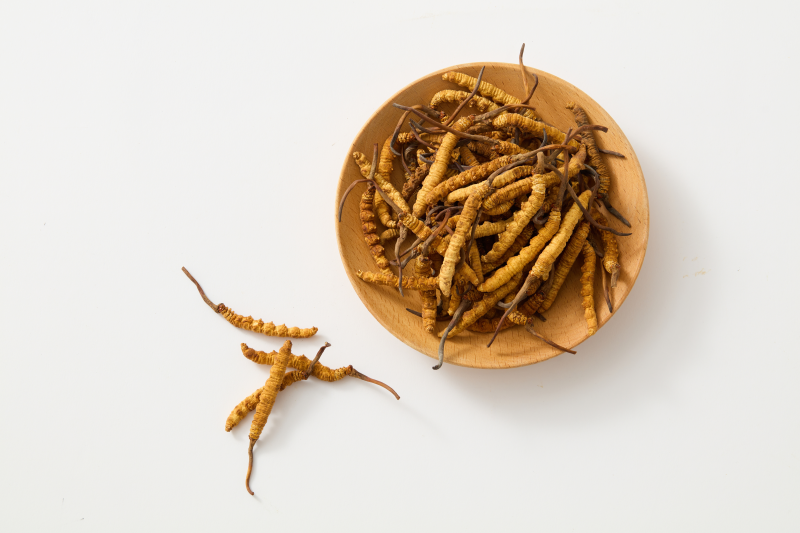
Cordyceps – strengthens the Kidneys and replenishes Yin and Yang. It is suitable for exhausted and elderly people, where the root cause is Kidney deficiency. It is generally not suitable for explosive, hot-blooded people with high blood pressure.
We use mushrooms according to the 5/2 rule = 5 days of use, 2 days break. Ideally, skip the weekend, that is easy to remember.
Patience and Realistic Expectations
Tinnitus that has lasted for years will not be corrected in two weeks. Even for Chinese medicine, solving tinnitus is a long-term process. We usually count on several months. In my experience, for some people, the sound significantly fades or stops being bothersome; for others, sleep and overall condition mainly improve. Where there is permanent hearing damage due to noise, the results tend to be more modest. Even so, it is worth trying.
Anyone taking medication for blood pressure, blood thinners, or other long-term medication should consult on the choice of mixture. And because the right mixture depends on the pattern, I recommend turning to the free MycoMedica Consultancy. It will help you choose what is right for you.
Tinnitus is a symptom that a person carries alone. Those around them cannot hear it or see it, and so they often do not take it seriously. This makes it all the more exhausting.
Chinese medicine sees it as a message from the body. Sometimes it says, "the reserves are empty." Sometimes, "it is all too much for me." And often both at the same time. When we understand which message it is, we know where to start.
And where not everything can be changed, an old prayer helps: the strength to change what can be changed, the serenity to accept what cannot be changed, and the wisdom to distinguish one from the other. This is doubly true for tinnitus. The less we fight it and the more we take care of sleep, peace, and moderation, the quieter it tends to be.
If you know someone who has ringing in their ears and who has already been told that they just have to live with it, send them this article. Perhaps it will help them understand what is happening in their body.
Take care and keep to the Middle Way. 🍄
Milan Schirlo Chinese medicine therapist and founder of MycoMedica

Subscribe to our newsletter and you won't miss any promotions or important information